
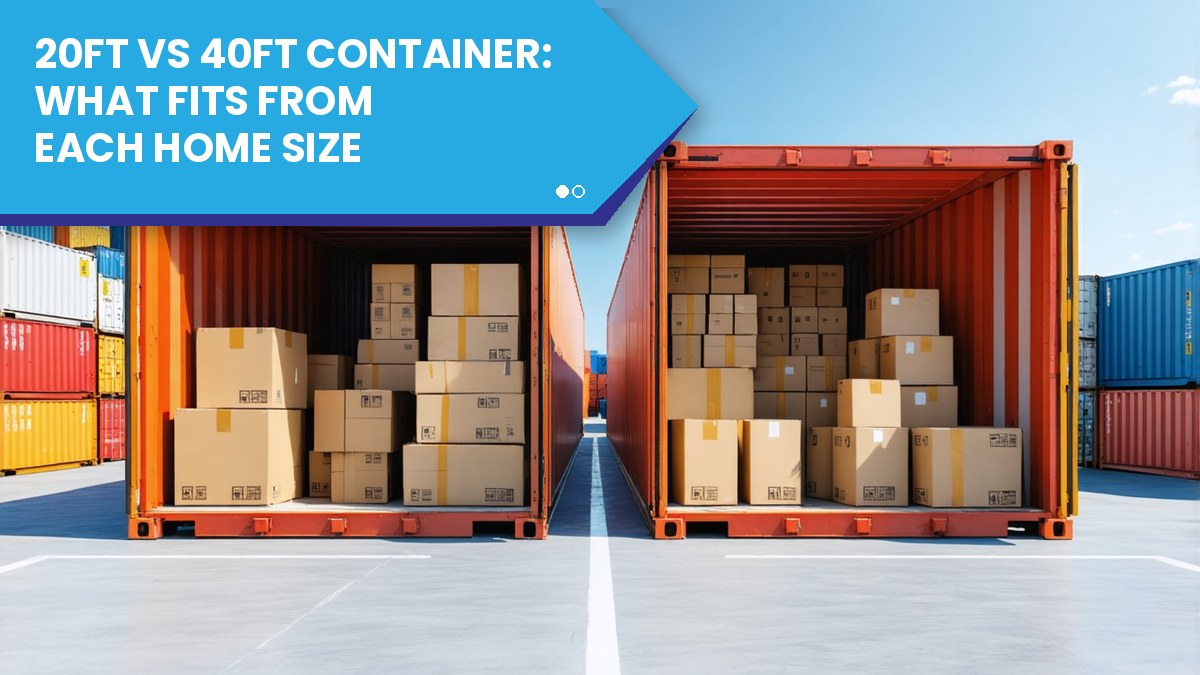
The 20ft vs 40ft container choice comes down to volume. A 20ft holds 28 m3 and a 40ft holds 55 m3. A two-bedroom home (15 to 20 m3) suits a 20ft, a four-bedroom house (40 to 60 m3) needs a 40ft or a 40ft high cube, and a three-bedroom home can need either. Smaller moves suit a shared container.
The capacities and home-size volumes below are the figures CM Relocation publishes on its shipping volume estimate and shipping options pages. Your own volume is measured at a free survey.
How much does each container hold?
CM lists three container sizes for personal effects: a 20ft container at 28 cubic metres, a 40ft container at 55 cubic metres, and a 40ft high cube at 62 cubic metres. The high cube is one foot taller than a standard 40ft, which is where its extra capacity comes from.
Container sizes follow an international standard. The International Organization for Standardization (ISO) classifies series 1 freight containers by their external dimensions in ISO 668, so the 20ft and 40ft sizes are standard sizes, not something each shipping line sets for itself.
Choosing a shipping container size for household goods starts with those numbers. To picture a cubic metre: eight of our standard cartons, each 50 x 50 x 50 cm with a suggested packed weight of 25 kg, make 1 m3.
20ft vs 40ft container: which does each home size need?
A one-bedroom home (8 to 10 m3) suits LCL or groupage. A two-bedroom home (15 to 20 m3) suits a dedicated 20ft or groupage. A three-bedroom home (25 to 45 m3) can need either size. A four-bedroom house (40 to 60 m3) favours the larger one.
| Home size | Typical volume | Usual shipping option | Against a 20ft (28 m3) | Against a 40ft (55 m3) |
|---|---|---|---|---|
| Cartons only | 1 to 4 m3 | Air, LCL or groupage | Under a sixth of the space | Under a tenth of the space |
| 1-bedroom apartment | 8 to 10 m3 | LCL or groupage | About a third | About a fifth |
| 2-bedroom apartment | 15 to 20 m3 | Dedicated 20ft container (FCL) or groupage | Roughly half to three-quarters | Roughly a quarter to a third |
| 3-bedroom apartment or house | 25 to 45 m3 | Dedicated 20ft or 40ft container (FCL) or groupage | The low end nearly fills it; the high end is well over | Roughly half to over four-fifths |
| 4-bedroom house | 40 to 60 m3 | Dedicated 40ft or 40ft high cube (FCL) | Over capacity on the stated figure | From about three-quarters to slightly over |
Groupage is only available to the UK, Ireland and Europe, the USA, Canada, Singapore, Hong Kong and South Africa. Where it is not offered, the table’s other options still apply.
Why does a three-bedroom home sit between a 20ft and a 40ft container?
A three-bedroom home sits between the two because its range, 25 to 45 m3, runs from just under a 20ft’s 28 m3 to most of a 40ft’s 55 m3. Two three-bedroom homes can need different containers, depending on how much furniture is in them.
The stated capacity is also not the same as the space you can fill. Sofas, wardrobes, bicycles and other odd-shaped furniture do not stack as neatly as cartons, so some space inside a container goes unused. For that reason a household at the top of a container’s range deserves a second look at the next size up.
- A 3-bedroom home at about 25 m3 is close to the limit of a 20ft, and a few extra items could tip it over.
- A 3-bedroom home at about 45 m3 is a clear 40ft case.
- Anything in the middle of the range is where measuring, not guessing, matters most.
When does a 4-bedroom house need a 40ft high cube?
For a four-bedroom house, the 40ft container is the realistic start: 40 to 60 m3 comes close to the 55 m3 of a standard 40ft, and the top of the range goes past it. A 40ft high cube holds 62 m3, so it gives the extra room and the extra height for a full house.
Even the low end of the range, 40 m3, is more than a 20ft’s 28 m3, so a full four-bedroom house starts at a 40ft. The survey confirms whether a standard 40ft is enough or the high cube is the better fit.
Height matters because tall pieces such as wardrobes and bookcases use the vertical space, and the high cube’s extra foot helps there. How many tall pieces you have is what tips the choice between the two.
When is a shared option better than a dedicated container?
Before weighing a 20ft vs 40ft container, check whether you need a dedicated container at all. When your goods fill less than about half of a 20ft, a shared option may cost less. You would be paying for space you are not using. That covers one-bedroom homes and anything shipped as cartons only.
If a dedicated container looks too big, our groupage vs LCL vs FCL comparison covers the shared options in full. In short, LCL packs your goods into wooden liftvans and consolidates them with other cargo for the same destination, while groupage shares a container with other households and waits at origin for it to fill. If you have only a few boxes, or need speed above all, the air freight vs sea freight guide is the better read.
What else decides between a 20ft vs 40ft container?
Volume is the main driver of the 20ft vs 40ft container decision, but four other things shape the choice: bulky items, a vehicle, access at the destination, and cost. Any one of them can move a household from one container size to the other.
- Bulky items: sofas, wardrobes and pianos take more room than their weight suggests and leave gaps around them.
- A vehicle: a car takes container space and has its own rules at the destination, so say so at the start.
- Destination access: a 40ft container is a larger load at delivery, so mention any access limits at either address at the survey.
- Cost: a larger container costs more in total, but the cost per cubic metre falls when it is full.
Cost matters in any 20ft vs 40ft container comparison, and our comparison page puts it simply: FCL is the highest cost overall but the most cost-effective per cubic metre if full. A 40ft container that is half empty loses that advantage, which is another reason the volume figure needs to be accurate.
How is the volume measured?
We measure the volume at a free survey, either in your home or by video. The survey covers every room, cupboard and storeroom and gives you a volume figure in cubic metres. Your quote follows the survey and settles the 20ft vs 40ft container choice, or confirms that a shared option suits your move better.
Before the survey, a few steps help get the container size right:
- Decide what is going and what is staying, including items in storage or a spare room.
- Note any large or fragile pieces, such as a piano or oversized wardrobes.
- Mention a vehicle if you plan to ship one.
- Tell us the destination address and any access limits there.
Frequently asked questions
How many cubic metres is a 20ft container?
On CM’s published figures, a 20ft container has a capacity of 28 cubic metres. That is the stated capacity. Odd-shaped furniture does not stack as neatly as cartons, so the volume you can actually fill is lower.
How many cubic metres is a 40ft high cube?
CM lists a 40ft high cube at 62 cubic metres. It is one foot taller than a normal 40ft container, which holds 55 cubic metres. The extra height suits tall furniture and larger households, particularly those near the top of the four-bedroom range.
Will a 3-bedroom house fit in a 20ft container?
Possibly, if your home is at the low end of the range. A three-bedroom home runs from 25 to 45 cubic metres on CM’s figures, and a 20ft holds 28. A lightly furnished flat may fit, while a fully furnished house is more likely to need a 40ft. Your survey decides.
Is a 40ft container twice the price of a 20ft container?
We do not publish container prices, so there is no figure to give here. What CM’s comparison page says is that a larger container costs more in total, but FCL is the most cost-effective per cubic metre if full. Your quote will confirm the actual cost.
Can I ship a car in the same container as my furniture?
A car takes container space, so it changes which size you need, and it has its own rules at the destination. Tell us at the start if a vehicle is part of the move, so your quote reflects it.
What if my belongings fill less than half a 20ft container?
A shared option may cost less, because a dedicated 20ft container means paying for space you are not using. LCL and groupage both suit smaller volumes. Groupage runs only to certain destinations, so check it covers yours.
Do I need a survey to choose a shipping container size for household goods?
Yes, the survey is how the 20ft vs 40ft container choice is made. CM’s volume ranges give a first idea, but two homes of the same size can hold very different amounts. Our survey is free, in your home or by video, and your quote follows it, naming the container or shared option that fits.
Book your free survey
If you are still weighing a 20ft vs 40ft container for your move, request a free quote and we will arrange a survey, in your home or by video. You can also call us on +65 6265 7664.
CM Relocation has moved households from Singapore since December 2016. We are a FIDI Affiliate, accredited to FIDI’s FAIM quality standard, and a member of the International Association of Movers (IAM). Let our family move yours.